


What is a Reverse Image Search API?
A Reverse Image Search API is a programmatic interface that allows applications to search the internet using an image as the query instead of text. Rather than typing "red vintage car," you upload an actual photo of that car, and the API finds similar or identical images across the web, along with related information about where those images appear, who owns them, and what they contain.

Why Image-Based Search is Becoming Increasingly Important
In today's digital landscape, we're experiencing an unprecedented shift toward visual communication. Social media platforms report that posts with images receive 650% higher engagement than text-only posts. Every day, billions of photos are uploaded to the internet, from Instagram snapshots to e-commerce product listings. This visual revolution has created new challenges: How do we verify the authenticity of an image? How can businesses protect their visual assets? How do consumers find products they've seen but can't describe?
The Visual Content Explosion
The numbers tell a compelling story. Over 3.2 billion images are shared daily across social platforms. E-commerce sites host hundreds of millions of product images. Stock photo libraries contain billions of licensed images. This massive growth of visual content online has created an urgent need for sophisticated tools that can verify authenticity, protect intellectual property, and enable discovery at scale. Traditional text-based search simply cannot address these challenges – we need technology that understands images as deeply as it understands words.
How Reverse Image Search APIs Work
The Technical Process: From Upload to Results
The journey of a reverse image search follows a remarkably elegant process that combines computer vision with massive-scale data processing:
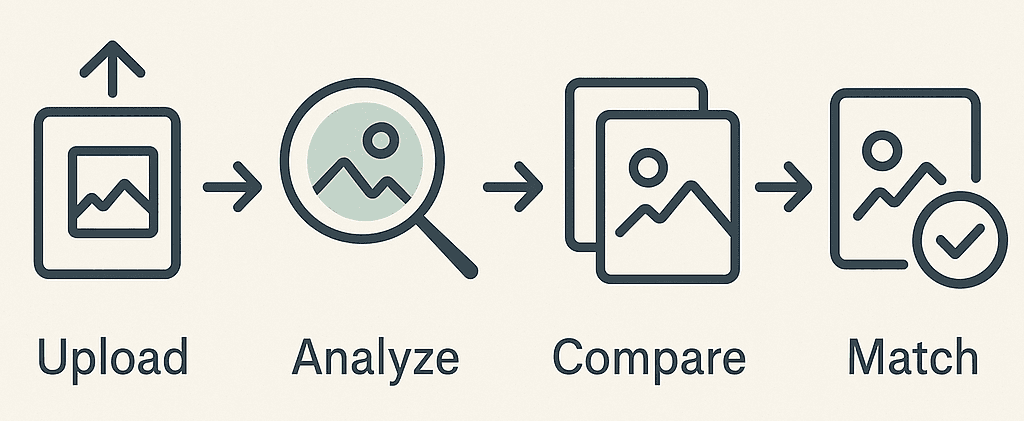
When an image is uploaded to the API, it first undergoes feature extraction. The system analyzes visual characteristics including colors, shapes, textures, and patterns. These features are converted into mathematical representations called feature vectors or visual fingerprints. The API then compares these fingerprints against billions of indexed images in its database, using sophisticated algorithms to identify matches based on similarity scores. Finally, the system returns results ranked by relevance, often including metadata such as image sources, dates, and contextual information.
The Fundamental Difference from Keyword-Based Search
Traditional keyword search relies on human interpretation and description. Someone must decide whether to call an item a "couch," "sofa," or "settee." This creates inherent limitations – language barriers, subjective descriptions, and the inability to describe complex visual elements accurately. Reverse image search eliminates these intermediary steps. The image speaks for itself, transcending language and subjective interpretation. A Ming dynasty vase is recognized as such whether the searcher knows its name or not.
Real-World Benefits That Drive Adoption
The advantages of reverse image search APIs extend far beyond simple convenience. Accuracy improves dramatically when visual similarity drives the search rather than textual description. A fashion retailer reported a 43% increase in successful product discoveries when implementing visual search. Speed transforms user experiences – what might take minutes of describing and refining keyword searches happens in seconds with an image upload. Large-scale discovery becomes possible when APIs can process thousands of images per minute, enabling businesses to monitor their visual assets across the entire internet continuously.
Mainstream Use Cases
Copyright Protection & Plagiarism Detection
Professional photographers and digital artists face an ongoing battle against unauthorized use of their work. Reverse image search APIs have become their first line of defense. These tools continuously scan the web for instances of protected images, alerting creators when their work appears without permission. Stock photo agencies use these APIs to track licensed image usage and identify violations. Design studios protect their client work from competitors who might steal visual concepts. The technology has recovered millions of dollars in unpaid licensing fees and prevented countless instances of creative theft.
E-commerce & Retail
The retail revolution is increasingly visual. Customers walking down the street can photograph a stranger's shoes and instantly find where to buy them online. Interior designers snap photos of furniture in hotels and locate suppliers within seconds. This visual commerce extends to sellers as well – merchants use reverse image search to verify the originality of their product photography, ensuring they're not inadvertently using copyrighted images. Major e-commerce platforms report that visual search drives 30% higher conversion rates than text search, fundamentally changing how consumers shop online.
Brand & Trademark Protection
Global brands invest millions in visual identity, making protection crucial. Reverse image search APIs scan online marketplaces for counterfeit products using stolen product photography or manipulated logos. Luxury brands identify fake merchandise on social commerce platforms before it reaches consumers. These APIs detect subtle modifications to trademarked imagery that might fool human reviewers but cannot escape algorithmic detection. One major sportswear brand reported identifying over 50,000 counterfeit listings in a single quarter using automated visual monitoring.
Journalism & Fact-Checking
In an era of viral misinformation, journalists rely on reverse image search APIs as essential verification tools. When a dramatic photo claims to show current events, fact-checkers can instantly trace its actual origin – often discovering the image is years old or from an entirely different incident. News organizations use these tools to verify user-submitted content, trace the spread of manipulated images, and provide readers with accurate context about viral photos. During major news events, these APIs process millions of images to separate authentic documentation from recycled or doctored content.
Social Media & Content Moderation
Social platforms face the monumental task of moderating billions of images daily. Reverse image search APIs identify and filter harmful content that has been previously flagged, preventing its re-upload across different accounts or platforms. They detect duplicate content that violates platform policies, identify coordinated inauthentic behavior using recycled images, and help maintain community standards at scale. These systems have become so sophisticated they can identify modified versions of prohibited content, even when filters, crops, or color changes have been applied.
Dating Apps & Identity Verification
Online dating platforms use reverse image search APIs to combat catfishing and romance scams. These tools verify that profile photos haven't been stolen from social media accounts or stock photo sites. When a too-good-to-be-true profile appears, the API can instantly reveal if those images belong to someone else entirely. Dating apps report that implementing visual verification reduced fake profiles by up to 60%, creating safer spaces for genuine connections. Some platforms now require visual verification as part of their standard onboarding process.
Insurance Fraud Detection
Insurance companies lose billions annually to fraudulent claims, many involving recycled or staged photos. Reverse image search APIs compare submitted damage photos against databases of previous claims, identifying when the same image of a crashed car or damaged property appears in multiple unrelated claims. These systems detect photos downloaded from the internet and submitted as evidence of personal loss. One major insurer reported a 35% reduction in fraudulent payouts after implementing automated image verification in their claims process.
Recruitment & Professional Platforms
Professional networking sites and recruitment platforms use reverse image search to maintain authenticity. These APIs identify when users upload stock photos as profile pictures or when the same professional headshot appears on multiple, supposedly different profiles. Recruitment agencies verify that candidate photos match their claimed identity, reducing the risk of identity fraud in hiring processes. This verification has become particularly important for remote hiring, where in-person verification isn't immediately possible.
Conclusion
The Evolution of Visual Intelligence
Reverse Image Search APIs have evolved from novel technology experiments into indispensable tools that power critical functions across industries. They protect creative professionals from theft, help consumers find products they love, shield brands from counterfeiting, and enable journalists to combat misinformation. These APIs have become the immune system of the visual web, constantly working to verify, protect, and connect visual information at a scale impossible for human review.
Creating Value Across the Spectrum
The true power of reverse image search APIs lies in their versatility. The same underlying technology that helps a photographer protect their copyright also helps a insurance company prevent fraud. It enables a fashion enthusiast to find their dream outfit while helping journalists verify the authenticity of breaking news photos. This broad applicability, combined with increasing accuracy and speed, has made visual search APIs essential infrastructure for the modern internet.
Looking Forward: The Visual-First Future
As our digital world becomes increasingly visual, searching with images will become as natural and essential as searching with words. The next generation won't think twice about photographing something to learn about it, buy it, or verify it. Reverse image search APIs are laying the foundation for this visual-first future, where the camera becomes our primary tool for navigating and understanding the world around us. The question isn't whether visual search will become ubiquitous – it's how quickly we'll wonder how we ever lived without it.
Latest Blog Posts

Spotting Real Estate Scams: How Reverse Image Search Protects Buyers and Platforms
The real estate market has always attracted fraudsters, but the digital age has made their schemes easier to execute and harder to detect. From fake rental listings to phantom property sales, scammers are using stolen images to create convincing facades that cost victims thousands — sometimes hundreds of thousands — of dollars.

Catching Fake Insurance Claims: Why Image Verification Has Become Essential
We've been working with reverse image search technology for years now, and one thing that keeps surprising us is how many industries are quietly dealing with the same problem: people submitting fake or recycled images to make money.

What is a Reverse Image Search API?
Reverse Image Search APIs let you search the web with images instead of words. They analyze a photo, match it against massive databases, and return similar results. Businesses use them to protect copyrights, fight fraud, verify identities, and improve shopping experiences. As the internet becomes more visual, image-based search is set to become as natural as text search.

Reverse image search - things you should know
Dive into the intriguing world of reverse image search. This guide illuminates its mechanics, benefits, and myriad applications. Learn how it empowers digital investigation, from validating image origins to discovering visually similar content.